


Organising a successful event requires more than arranging security personnel at entrances. The venue layout, access arrangements, crowd movement, emergency procedures and communication systems must work together to protect attendees, staff, contractors and performers.
To plan security for an event effectively, organisers need to identify potential threats, assess the venue’s infrastructure and establish clear procedures for managing crowds and responding to incidents. These considerations apply to outdoor festivals, corporate functions, sporting events, concerts, exhibitions and public gatherings across the UK.
A well-developed event security plan should be practical, proportionate to the event’s risks and understood by everyone with a security or safety responsibility. It should also account for how conditions might change before, during and after the event.
This guide explains the main elements of event security planning, from infrastructure and risk assessment to crowd protection, emergency response and post-event reviews.
1. Understanding the Foundations of Event Security Planning
Event security management is the process of identifying, preventing and responding to security risks associated with an organised gathering. It involves people, physical infrastructure, operational procedures and communication arrangements.
The level of planning required depends on several factors, including:
- Event size: The expected attendance and the number of people moving through the venue.
- Event type: A music festival, business conference and sporting event have different operational risks.
- Venue characteristics: Indoor buildings, temporary structures, open spaces and multi-entrance sites present different challenges.
- Audience profile: Families, children, VIP guests and general admission attendees may have different access and safeguarding requirements.
- Location: Transport links, surrounding roads, neighbouring properties and local conditions can influence security arrangements.
- Event duration: Extended operating hours, overnight activities and staggered departures can increase operational complexity.
The objective is not simply to increase the number of security staff. It is to create an organised system in which potential problems can be identified early and handled appropriately.
The relationship between security and event safety
Security and safety are closely connected, but they are not identical.
Security arrangements generally focus on preventing unauthorised access, managing disruptive behaviour, protecting people and property, and responding to security incidents.
Event safety also considers wider hazards such as fire, structural failure, electrical risks, severe weather, medical emergencies and unsafe crowd conditions.
A reliable planning process considers both areas together. For example, an entrance checkpoint must provide effective access control without creating queues that obstruct emergency routes or cause dangerous crowd pressure.
This is where well-designed Event security infrastructure becomes important. Physical arrangements, security personnel and operational procedures should support one another rather than operate as separate elements.
2. Assessing Event Infrastructure Before the Event
The physical layout of an event has a direct influence on how security operations function. Even a well-staffed event can experience problems if entrances are poorly positioned, emergency routes are obstructed or different crowd movements overlap.
Infrastructure planning should begin during the venue assessment stage, rather than after the event layout has been finalised.
Entrance and exit arrangements
Every entrance and exit should have a clearly defined purpose.
Organisers should consider:
- Main public entrances and exit points.
- Staff, contractor and supplier access.
- VIP or restricted-access entrances, where applicable.
- Emergency exits and evacuation routes.
- Accessible entrances for people with mobility requirements.
- Vehicle access points for authorised deliveries and emergency services.
Access control should be proportionate to the event’s risk profile. Ticket checks, accreditation systems, bag policies and vehicle inspections may be appropriate depending on the circumstances.
It is equally important to plan how people will move away from entrance checkpoints. Security screening should not create unnecessary congestion or obstruct other pedestrian routes.
Perimeter security and boundary protection
A clearly defined perimeter helps distinguish public areas from restricted operational spaces.
For outdoor events, this may involve temporary fencing, barriers, controlled gates and designated vehicle access points. At indoor venues, existing walls, doors, reception areas and access-control systems may provide some of the necessary separation.
The assessment should identify:
- Areas accessible to the general public.
- Restricted staff and operational zones.
- Equipment storage and backstage areas.
- Temporary structures and service compounds.
- Vulnerable perimeter sections.
- Locations where unauthorised entry could disrupt operations.
Perimeter arrangements should also allow emergency access and avoid creating obstacles for evacuation.
Security control points and surveillance
Control points provide locations from which access, activity and potential incidents can be monitored.
Depending on the venue, these may include staffed entrances, security reception points, CCTV monitoring facilities and designated incident coordination areas.
CCTV can support situational awareness by helping authorised operators observe activity in relevant areas. However, cameras should complement rather than replace physical security presence and appropriate incident response procedures.
Organisers should also consider camera positioning, lighting, communication coverage and the practical limitations of monitoring crowded or temporary event spaces.
3. Conducting a Thorough Event Security Risk Assessment
A risk assessment provides the foundation for deciding which security measures an event needs. It should be based on the actual venue, audience, activities and operating conditions rather than a generic checklist.
The Health and Safety Executive (HSE) recommends assessing crowd-related hazards throughout the arrival, entry, movement, exit and dispersal stages of an event.
Identify potential security threats and hazards
Start by identifying situations that could put attendees, staff or the event itself at risk.
Common considerations include:
| Risk area | Potential concerns | Planning considerations |
| Unauthorised access | People entering restricted areas | Ticket checks, accreditation and controlled access |
| Crowd congestion | Overcrowding and blocked walkways | Queue management and crowd monitoring |
| Disorderly behaviour | Aggression, disputes and disruptive conduct | Trained security personnel and escalation procedures |
| Theft and property damage | Theft of equipment or personal belongings | Patrols, surveillance and secure storage |
| Vehicle movements | Conflicts between pedestrians and vehicles | Segregated routes and controlled vehicle access |
| Medical emergencies | Injury, illness or sudden collapse | Clear reporting and emergency access arrangements |
| Fire and evacuation | Fire, smoke or blocked escape routes | Evacuation procedures and coordination with safety teams |
| Severe weather | High winds, heavy rain or extreme temperatures | Weather monitoring and contingency arrangements |
This is a starting point, not an exhaustive list. The assessment should reflect the specific event and its circumstances.
Evaluate likelihood and potential consequences
Once hazards have been identified, assess how likely they are to occur and how serious their consequences could be.
For example, an outdoor event with temporary fencing, multiple entrances and vehicle delivery areas may require particular attention to perimeter security and vehicle-pedestrian separation.
A useful assessment should record:
- The hazard or threat identified.
- Who could be affected.
- The likelihood and potential severity.
- Existing control measures.
- Additional measures required.
- The person responsible for implementing them.
- When the controls will be reviewed.
Risk assessments should be reviewed when the event layout changes, attendance expectations increase, weather conditions deteriorate or new information identifies an additional risk.
Involve the right people
Event security planning should not be carried out in isolation.
Depending on the event, relevant stakeholders may include:
- Event organisers and venue management.
- Security managers and supervisors.
- Health and safety advisers.
- Police and local authorities, where appropriate.
- Fire and rescue services.
- Medical providers.
- Transport and traffic management teams.
- Contractors responsible for temporary structures and equipment.
Clear communication between these parties helps prevent gaps in responsibility.
4. Developing a Security Plan for an Outdoor Event
Outdoor events present challenges that may not exist within permanent indoor venues. Open boundaries, changing weather, temporary infrastructure and large areas of public access can make security operations more complicated.
A security plan for outdoor event operations should consider the entire site, including the surrounding environment.
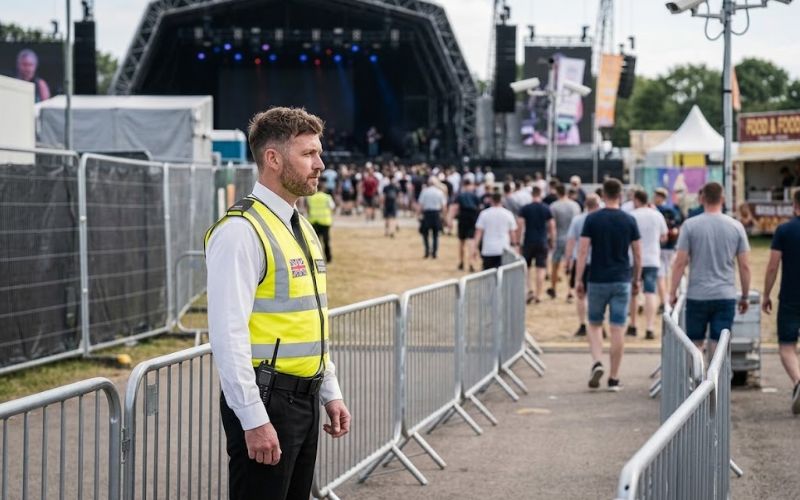
Establish clear site boundaries
Organisers should identify the event footprint and determine how different areas will be controlled.
This may involve:
- Temporary perimeter fencing.
- Designated entry and exit gates.
- Restricted backstage and production areas.
- Staff-only compounds.
- Controlled vehicle access.
- Clearly marked emergency routes.
Temporary fencing should be suitable for its intended purpose and installed with consideration for ground conditions, weather exposure and crowd pressure.
Plan for changing weather conditions
Weather can affect both infrastructure and crowd behaviour.
High winds may affect temporary structures, signage and barriers. Heavy rain can create slippery surfaces, standing water and difficult access routes. Extreme heat can increase the need for welfare arrangements and medical support.
Organisers should establish who monitors weather conditions and who has authority to recommend operational changes, suspend activities or initiate an evacuation.
Manage vehicle and pedestrian separation
Outdoor festivals, sporting events and public gatherings may involve delivery vehicles, production transport, emergency vehicles and pedestrian traffic operating in the same general area.
Where possible, separate these movements through designated routes, controlled access points and suitable barriers.
Vehicle movements should be coordinated with the event schedule to reduce unnecessary interaction with attendees.
Consider the surrounding location
An event does not operate independently of its surroundings.
For example, an outdoor gathering in central London may need to consider nearby public transport stations, pedestrian routes, commercial premises, residential streets and traffic restrictions.
Organisers arranging Event security London should therefore assess the surrounding environment alongside the event footprint. Local access conditions, neighbouring activities and expected arrival patterns can influence where security resources are needed.
5. Crowd Management and Attendee Protection
Crowd protection is one of the most important elements of event security management. Poor crowd management can turn an otherwise manageable situation into a serious safety incident.
Effective planning considers how people move, where they gather and how their behaviour may change throughout the event.
Manage the three main stages of crowd movement
Arrival and entry
The arrival stage can create congestion around ticket checkpoints, transport connections and venue entrances.
Planning should account for:
- Expected arrival patterns.
- Entrance capacity and queue space.
- Ticket verification procedures.
- Accessible entry arrangements.
- Clear directional signage.
- Communication with attendees about entry requirements.
Movement within the venue
Once attendees enter, organisers need to consider how people move between different areas.
Potential congestion points include food and drink facilities, toilets, merchandise stands, stages, exhibition areas and narrow walkways.
Security supervisors should know where crowd build-ups are most likely and how to report changing conditions.
Exit and dispersal
The end of an event can create significant movement as large numbers of people leave at the same time.
Organisers should consider exit capacity, pedestrian routes, public transport connections and vehicle movements.
Staggered departures or managed exit arrangements may be appropriate in certain circumstances, provided they are consistent with the event’s wider safety and evacuation procedures.
Use barriers appropriately
Crowd barriers can help define routes, protect operational areas and separate different types of movement.
However, barrier placement requires careful assessment.
Poorly positioned barriers can create bottlenecks, restrict movement or introduce additional hazards during an emergency.
Their selection and positioning should consider crowd dynamics, the intended purpose, ground conditions and the availability of alternative routes.
HSE guidance on crowd management emphasises the importance of venue design, effective controls and ongoing monitoring rather than relying on barriers alone.
Protect vulnerable attendees
Crowd planning should account for people who may need additional assistance, including:
- Children and young people.
- Older attendees.
- People with disabilities.
- Individuals with mobility difficulties.
- People who become separated from companions.
- Attendees experiencing medical or welfare difficulties.
Accessible routes, clear communication and appropriate assistance procedures should be considered during the planning stage.
6. Security Personnel, Responsibilities and Communication
Even a well-designed security plan can fail if personnel do not understand their responsibilities.
The event security management plan should define reporting lines, operational positions and escalation procedures before staff begin their duties.
Allocate clear security responsibilities
Depending on the scale and complexity of the event, responsibilities may be assigned across several roles.
| Role | Main responsibility |
| Event security manager | Overall coordination of security operations |
| Security supervisor | Managing assigned personnel and operational areas |
| Access control personnel | Monitoring entrances and checking authorisation |
| Patrol personnel | Observing activity and reporting concerns |
| Crowd management personnel | Supporting safe movement and identifying congestion |
| Control room personnel | Coordinating information and incident reporting |
The exact structure should reflect the event’s requirements. Smaller events may combine some responsibilities, while larger operations may require separate teams.
Establish a reliable communication system
Security personnel need a consistent method of sharing information.
Two-way radios are commonly used for operational communication, particularly where mobile phone coverage may be unreliable or multiple teams need to coordinate quickly.
Before the event, establish:
- Radio channels and call signs.
- Reporting procedures.
- Emergency communication protocols.
- Escalation contacts.
- Backup communication arrangements.
- Procedures for reporting incidents and requesting assistance.
A central control point can help supervisors maintain an overall picture of crowd conditions, developing incidents and staff deployment.
HSE guidance also recommends considering backup arrangements if electrical communications or public address systems fail.
Check relevant SIA licensing requirements
Where contracted security personnel undertake licensable activities, the appropriate Security Industry Authority (SIA) licence may be required.
The distinction between a door supervisor and security guard licence depends on the activity being undertaken and the circumstances of the work.
For example, the SIA explains that guarding duties connected with licensed premises, where alcohol is supplied or regulated entertainment takes place, can require a door supervisor licence. Other contracted security guarding activities may require a security guard licence. Specific exemptions and circumstances can affect the position.
Event organisers should check the relevant requirements when appointing security providers and allocating duties. A job title alone does not determine whether a licence is necessary.
7. Emergency Response and Incident Management
An event security plan must explain what happens when something goes wrong. Identifying risks is only part of the process; personnel also need clear instructions for responding to incidents.
Emergency procedures should be developed with the relevant event management, safety and emergency response teams.
Establish incident reporting procedures
Security personnel should know how to report:
- Suspicious activity or unattended items.
- Aggressive or threatening behaviour.
- Unauthorised access.
- Missing children or vulnerable individuals.
- Crowd congestion or dangerous movement.
- Medical emergencies.
- Fire or other immediate hazards.
Reports should reach the appropriate supervisor or control point without unnecessary delay.
Prepare for evacuation and other emergency actions
Not every emergency requires the same response. Depending on the circumstances, it may be safer to evacuate an area, move people to a safer location, restrict movement or provide specific instructions.
The plan should identify:
- Who can initiate emergency procedures.
- How staff will receive instructions.
- How attendees will be informed.
- Which routes or areas may be used.
- How emergency services will access the site.
- How people requiring assistance will be supported.
- How staff will account for incidents and communicate updates.
Security staff should understand their role within the wider emergency plan. They should not undertake responsibilities outside their training or authority.
Consider counter-terrorism preparedness
Protective security should form part of the event’s wider risk assessment.
The UK Government’s Terrorism (Protection of Premises) Act 2025 is commonly known as Martyn’s Law. It introduces requirements for certain premises and qualifying events to improve preparedness and public protection against terrorism.
As of November 2026, the substantive requirements have not yet come into force. The Government expects implementation in spring 2027, with the precise commencement date to be confirmed.
The Act includes qualifying events where it is reasonable to expect at least 800 individuals to be present at the same time, subject to the other statutory conditions and exclusions. It also establishes different requirements depending on the applicable tier.
Event organisers should consult the latest Home Office guidance to understand whether their premises or event may fall within scope and prepare accordingly.
Protective security planning should also consider staff awareness, incident reporting, emergency communication and procedures for responding to a suspected threat.
8. Building a Coordinated Event Security Management Plan
A successful security operation requires more than individual measures. Every element should form part of a coordinated plan that can be understood, implemented and reviewed.
A structured event security approach should bring together the risk assessment, site layout, personnel deployment, communication arrangements and emergency procedures.
For organisers planning festivals, concerts, corporate events or public gatherings, Structured event security helps connect these different operational requirements into a consistent framework.
What should the security plan contain?
The document should be tailored to the event, but commonly includes:
- Event information: Date, location, operating hours, expected attendance and event activities.
- Site layout: Entrances, exits, restricted areas, emergency routes and operational facilities.
- Risk assessment: Identified hazards, risk levels and control measures.
- Security deployment: Personnel positions, supervisory structure and responsibilities.
- Access control: Ticket checks, accreditation and authorised vehicle arrangements.
- Crowd management: Queue management, pedestrian movement and capacity monitoring.
- Communication: Radio procedures, control point arrangements and escalation contacts.
- Emergency response: Incident reporting, evacuation and coordination procedures.
- Contingency arrangements: Responses to adverse weather, infrastructure problems and operational disruption.
- Review procedures: How incidents, changes and lessons learned will be recorded.
Carry out a pre-event operational briefing
Before opening the venue to attendees, relevant personnel should receive a briefing covering their assignments and responsibilities.
The briefing should explain:
- Their designated positions and reporting lines.
- Entry and restricted-access procedures.
- Expected crowd movement.
- Communication protocols.
- Emergency procedures.
- Relevant risks and control measures.
- Procedures for escalating incidents.
A site walk-through can also help identify issues that may not be obvious from a written plan, such as obstructed access routes, poorly positioned signs or gaps in communication coverage.
Monitor and review the plan during the event
Security arrangements should not remain fixed if conditions change.
For example, an unexpected increase in attendance, a blocked pedestrian route or a sudden change in weather may require supervisors to review existing controls.
The security management team should maintain regular communication with event organisers and relevant operational teams so that decisions are based on current conditions.
9. Planning Security for Large Events
Large events introduce additional operational challenges because of their attendance levels, site complexity and the number of organisations involved. Organisers often need the support of a large event security company to coordinate security arrangements across multiple areas.
A large music festival, public celebration or sporting event may involve several entrances, temporary structures, multiple activity zones and substantial pedestrian movement outside the main venue.
Large event security therefore requires careful coordination across different operational areas, with suitable security personnel, access control and crowd management procedures in place.
Particular considerations include:
Multiple access points: Each entrance needs a defined purpose, suitable staffing and consistent access procedures.
Deployment across large sites: Security personnel should be assigned to clearly identified zones, with supervisors responsible for coordinating their teams.
Crowd capacity: Organisers should monitor attendance and crowd distribution rather than relying solely on ticket sales or overall site capacity.
Transport and traffic: Pedestrian routes, public transport connections, vehicle access and nearby roads should be considered together.
Incident coordination: A central reporting structure helps ensure that information reaches the people responsible for operational decisions.
Contingency planning: Organisers should consider how security arrangements will adapt if an entrance becomes unavailable, weather affects the site or an incident disrupts normal operations.
The scale of the event does not automatically determine the exact number of security personnel required. Deployment should be based on a documented assessment of the venue, activities, crowd profile and identified risks.
10. Common Event Security Planning Mistakes
Some problems arise not because organisers have no security arrangements, but because important operational details have been overlooked.
Common mistakes include:
- Planning security too late: Security requirements are considered after the venue layout and infrastructure have already been finalised.
- Relying on staff numbers alone: More personnel do not automatically resolve poor access arrangements or inadequate crowd controls.
- Ignoring departure arrangements: Attention is focused on entry, while crowd dispersal receives insufficient consideration.
- Unclear reporting responsibilities: Personnel are unsure who should receive incident reports or authorise operational changes.
- Poor coordination with contractors: Security, production, transport and venue teams work independently without a shared operational plan.
- Failing to review changing conditions: Existing arrangements are not reconsidered when attendance, weather or site conditions change.
- Overlooking accessible arrangements: Evacuation and crowd movement plans do not adequately account for people requiring assistance.
- Inadequate staff briefings: Personnel arrive without a clear understanding of their positions, responsibilities or emergency procedures.
Avoiding these mistakes requires early preparation, realistic risk assessments and regular communication between everyone involved in delivering the event.
11. Event Security Planning Checklist
Before an event opens, organisers should confirm that the main security arrangements are in place and that the relevant personnel understand their responsibilities.
The following checklist provides a practical starting point:
- Complete an event-specific security risk assessment.
- Review the venue layout and identify potential security vulnerabilities.
- Establish clearly defined entrances, exits and restricted areas.
- Check perimeter arrangements and temporary infrastructure.
- Plan pedestrian movement and queue management.
- Establish suitable security personnel deployment.
- Confirm relevant SIA licensing requirements.
- Establish communication channels and reporting procedures.
- Coordinate emergency response arrangements.
- Review fire, evacuation and medical access arrangements.
- Brief security personnel, supervisors and relevant contractors.
- Check contingency arrangements for changing conditions.
- Monitor operations and record incidents during the event.
- Conduct a post-event review and identify improvements.
This checklist should be adapted to the size, nature and risk profile of the event. It does not replace a formal risk assessment or other applicable safety requirements.
Frequently Asked Questions
What should be included in an event security plan?
An event security plan should include the venue layout, risk assessment, access control arrangements, security personnel responsibilities, crowd management procedures, communication systems and emergency response arrangements. It should also identify who is responsible for implementing and reviewing each measure.
How do you assess security risks before an event?
Start by reviewing the event location, expected attendance, audience profile, activities and surrounding environment. Identify potential hazards, assess their likelihood and consequences, and determine appropriate control measures. Review the assessment whenever circumstances or operational arrangements change.
What security measures are needed for an outdoor event?
Outdoor events may require perimeter fencing, controlled access points, vehicle management, designated pedestrian routes, security patrols, communication systems and weather-related contingency arrangements. The appropriate measures depend on the site layout, event activities and identified risks.
Who is responsible for event security management?
The event organiser or person responsible for the event must ensure that appropriate arrangements are made for managing relevant risks. Security managers and supervisors may coordinate security operations, while venue management, contractors and other stakeholders have responsibilities within their respective areas. Responsibilities should be clearly agreed before the event.
Do event security staff need an SIA licence in the UK?
Some event security duties require an SIA licence, but the requirement depends on the activity and circumstances. For example, contracted security guarding at licensed premises where alcohol is supplied or regulated entertainment takes place may require a door supervisor licence. Other activities may fall under different licensing requirements. Organisers should check the SIA’s official guidance for the specific duties involved.
How often should an event security plan be reviewed?
The plan should be reviewed during preparation and whenever significant changes affect the event’s risk profile. This includes changes to attendance expectations, venue layouts, access arrangements, weather conditions or identified threats. A post-event review can also help improve arrangements for future events.